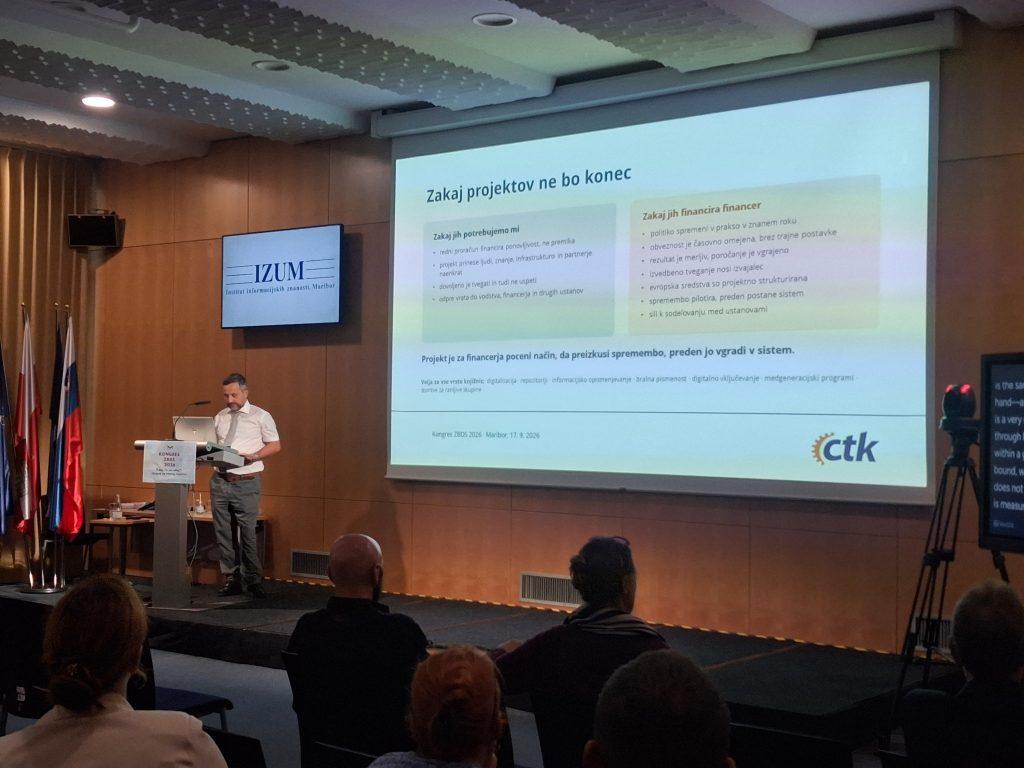
At the ZBDS 2026 Congress, held between 16 and 18 September 2026, which addressed the question ‘When, if not now?’, representatives of the Central Technical Library of the University of Ljubljana (CTK) were among the speakers and participants in the round-table discussions.
Director of CTK Tilen Mandelj In addition to his opening address, he gave a lecture on the topic of Is the project coming to an end? and took part in a round-table discussion The Librarians in the Slovenian context, Dr,. Tea Romih and she was a participant in the round-table discussion Centres of excellence: from the experience of general libraries to a model for the Slovenian library sector? Here are some highlights from the lectures at the congress.
»No. The project-based approach is not coming to an end. If that was a concern of yours, you can leave here feeling reassured. The project-based approach is here to stay, and rightly so. Much of the development we’ve achieved in libraries over the last twenty years has been made possible precisely by project funding. I’ll also show why funding these projects is in the funder’s interest and why this will remain the case.”.
The real question, then, is another one, and it is one that truly concerns me as director: how can the services we have developed as part of project funding survive and be integrated into the library’s day-to-day operations? Because projects have one unfortunate characteristic. From the very day they begin, we know when they will end. They are probably one of the few entities for which the date of death is known at the moment of birth. But the user’s needs do not read the project contracts, nor do they disappear on the final day.«
In his lecture entitled Is the project coming to an end? explained Tilen Mandelj, director of CTK. He showed the audience how the services developed using project funding can be sustained and become part of the library’s day-to-day operations.
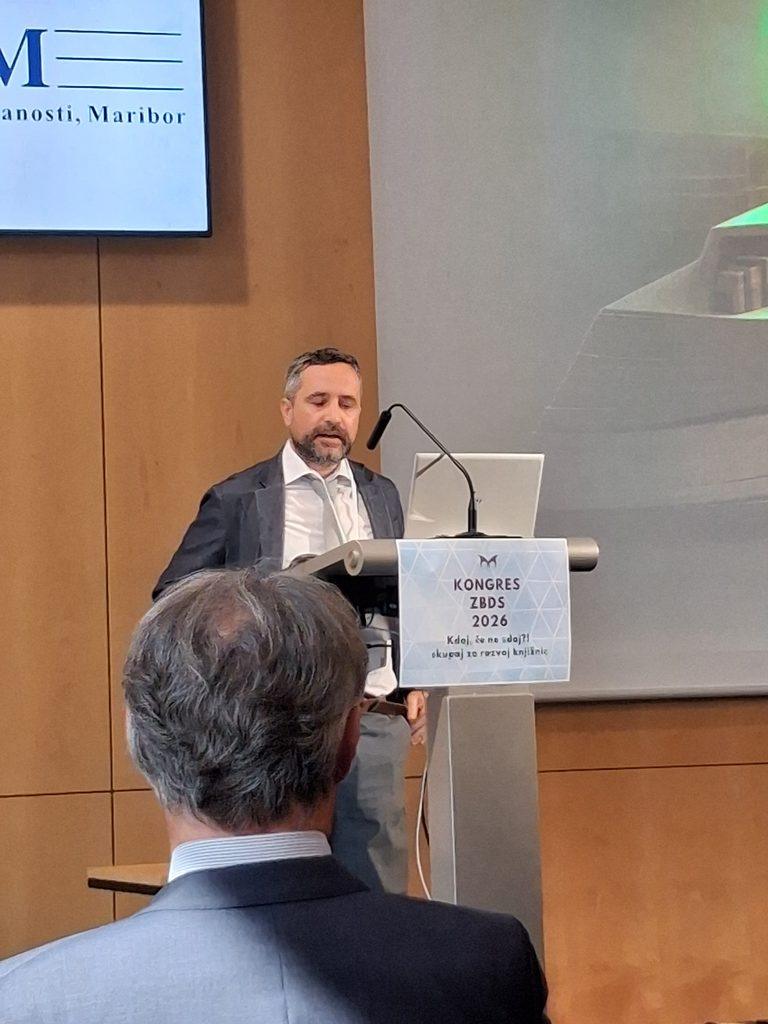
In his opening address, he urged the participants to bear one question in mind throughout all the lectures and discussions: not what your library should be like in ten years’ time, but what must a library be capable of changing?
He also took part in a round-table discussion organised in response to the film The Librarians with a focus on what this means for the situation in Slovenia. Among other things, Mandelj spoke about the fact that, within the context of open science (in areas such as repositories, persistent identifiers, digital preservation, etc.), it is important to emphasise that this involves, amongst other things, infrastructure for resilience.
When the discussion turned to the high-profile bans often imposed on school and public libraries, he pointed out that, on the other hand, »silent selection« can be a pressing problem. Not the removal of a book from the shelf, but rather what is not purchased in the first place, which event is “not worth it at the moment”, and which collection is not given prominence? He also wondered where the line lies between acquisition policy and silent selection — and how one would even measure it?
In conclusion, he emphasised that the libraries in the film which had weathered the pressure had a documented acquisition policy and a procedure for dealing with user complaints regarding materials. Without this, the responsibility falls on the individual librarian.